Showing posts with label PTSD. Show all posts

Monday, August 1, 2016

Back to Stage One of Healing: More on Safety and Stabilization


It's been quite a month, and life is settling back into something like normal. Redeeming Dinah, the blog exploring the Duggar Phenomenon as a function of the family agenda promoted among many Independent Fundamental Baptists is up and running. It's been a month since the panel where survivors of the system talked about their experiences. Afterwards, I returned home from Dallas to be met with a couple of deaths of loved ones, some injuries, and the sadness that goes along with them. The dog days of summer do not make matters any easier.

It's now been several months (!) since a post about the stages of trauma, and I have plenty more material upon which to draw to illustrate the journey of healing. I aspired to take the high road through a miserable process of injustice and gossip from people whom I respect and to show them love. I think I've learned lessons about anger and love, about people who are unsafe, about how difficult it can be to figure out all of that, and more. I'm reminded that the people who mean the most to me whose opinions really matter are all that really matter, even though gossip can do much damage. 

Saturday, June 11, 2016

What are Your Barriers?

This is a nice image.  (Though I suspect that the volatiles in the ink had more to do with the ant's behavior.)  But that's still a barrier, and there just might be unbounded freedom on the other side of yours.


BE FREE!

Tuesday, April 19, 2016

Daffodils Along the Way of the Higher Path


Through daffodils forgotten and found and reclaimed in my recent meltdown, perhaps those reading here can catch a glimpse of how healing from trauma can unfold. In the writing of this, I am almost amused by how spontaneously the whole concept bubbles up in me. I spent many years wondering whether I ever even know joy because it seemed that I'd forgotten because trauma alienated me from the memories of it. I couldn't find it no matter how hard I tried.

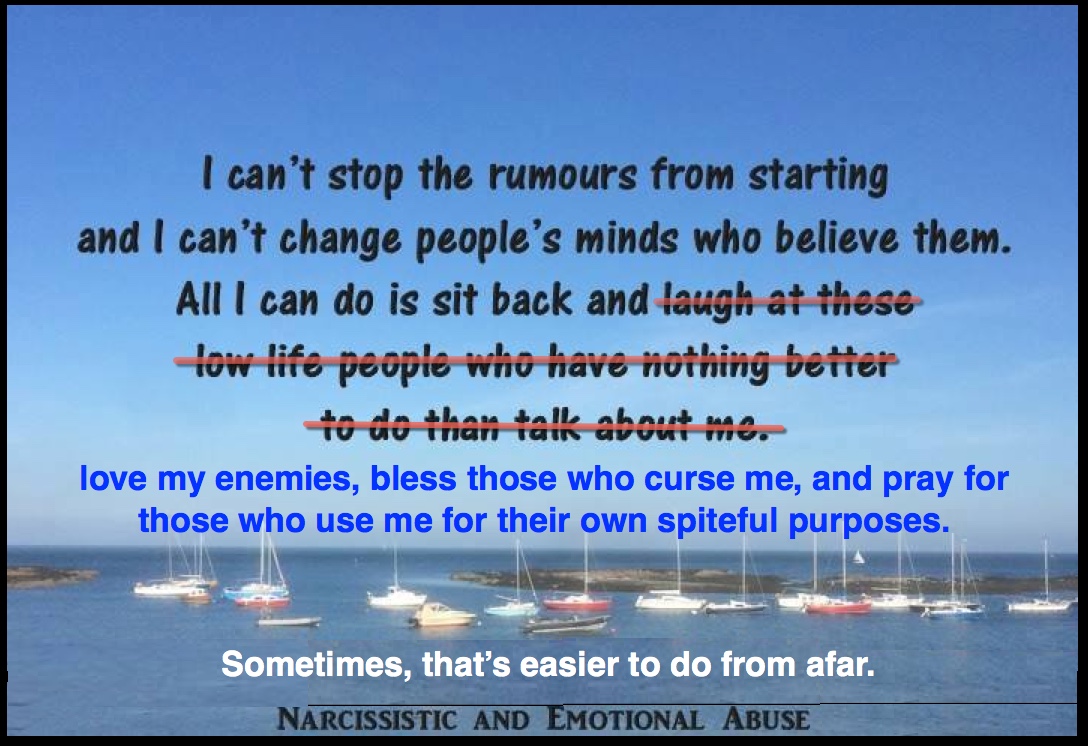
Having already defined my dilemma of moving through the Third Stage of healing in the last post, I feel as though I tackled the integration element well. Moving forward and reconnecting, the other tasks involved in Stage Three, blend for me in what I have yet to work through. I noted an example of a meme that objected liars and gossips as “lowlifes,” yet I wanted to aspire to something better. But I hadn't figured out how to get to “the high road,” having made the choice to seek resolution of conflict as opposed to perpetuating it. For my own benefit, I wanted and needed to aspire to something better.

Disclaimer: Everyone has to find their own way through their conflict in ways that work well for them, and It's important to note that not everything works for everybody. I draw on my own supportive beliefs to transcend pain and loss and trauma, though I understand and expect that many people will find their way through such conflicts differently. I also find myself at a point in my own exemplar conflict where I've come to terms with my anger and the injustice. I also don't want anyone to misunderstand this approach as offering forgiveness to people who aren't sorry for what they've done. I do hope to see justice for everyone involved. Taking an approach that avoids marking people as adversaries or that comes from the secure perspective that love can offer shouldn't be mistaken for cheap forgiveness that ignores justice. (Here's an index of over seventy blog posts that basically argue that without justice, forgiveness and mercy are meaningless.)

Monday, April 18, 2016

Daffodil Season Ends but Recovery Continues


More than a month ago, I learned about some cruel gossip that's being spread about me and it triggered a host of complicated hurdles for me. The questions of others sent me back to revisit my history of hopping around through some truly fringe varieties of cultic Christianity, but I also found myself more affected by the deep personal losses that are all wrapped around that history, too.

Ironically, I'd just started blogging about the stages of recovery right before this happened, but I suddenly realized that I was living an experiential reminder, too. Stage One persisted for a good two weeks before it faded into decrescendo, mostly because I still can't understand that if people took issue with me that they didn't feel comfortable with approaching me. And the truth is that there may be no rational reason behind their actions.

Concurrent with seeking stability came the grieving of Stage Two (Part 2) as did remembrance (Part 3). That grieving involved identifying and expressing my anger in a healthy way – once I was able to identify it as anger. Some Stage Three surprised me pleasantly in renewal of old friendships. Elements of safety in recovery emerged, too, for I found that while I was coping with my own emotional soup, those who love me also became offended on my behalf. At times, I had to juggle their responses when I wasn't exactly in the best form myself.


Integration and Reconnection

Though I hate to realize it, this challenge did affect me strongly enough that I've recoiled in constriction. Though a string of my own illnesses and my concerns for my aging cat's health have added to stress, I realized that I'd fallen into my familiar old pattern of retreat. Friends have been calling, wondering where I am and whether I still love them.

As my shock and awe abates, I'm now faced with connecting again with those things and people from whom I've backed away. Social isolation never helps, and I find myself working hard to pull out of it. Time with others heals me, but I feel weary. I've neglected self care along with my friends. I struggle to attend to work projects as the stress of the conflict seems to run at a low level, but constantly in background in my mind.

Then there are other things that leave me weary like the announcement that CJ Mahaney was speaking at The Gospel Coalition. I also look forward to writing about Eric Pazdziora's the beautiful lament that he composed for Lydia Schatz which was recently featured at a Chorosynthesis event. (Lydia was the Liberian adoptee who died a few years ago due to beatings according to her parents' observance of Michael Pearl's teachings.) John Weaver's excellent new book about the New Apostolic Reformation brings up another set of ideas and history that I must revisit as I read.

And with both Eric and John who could almost be my sons age wise, in my joy over their recent accomplishments, there is a tinge of melancholy. I planned on having my own children but I didn't get the life I ordered. In this season of remembrance for me and as I approach my fiftieth birthday, the subject of opportunities lost takes on greater significance. Eric has also been a kind ear and encouragement for me as I set out to reclaim my connection to music which I largely buried after I left my church nineteen years ago. (That's part of another aspect of my ongoing recovery that finally emerged about a year ago.)


Reconnection and Moving On

So here I am, waiting to see what unfolds regarding my relationships with people who are claiming that there are elephants in the room. I have a talent for pointing out the fact that naked emperors have no clothes, often at the worst possible moment. I have to interact with many people involved in the telling and in the hearing of the elephant tales before we all have a good opportunity to address these matters.

I must make it an adventure of learning not to care too much about those things which I can't do anything about. I may ultimately just chose to walk away from the endeavor that links me to these critics. I might stay involved but just suffer the slings and arrows of outrageous ideas because it's just not worth the effort of opposing them. I can't end them, either, but I can address them assertively. Not knowing more about how the conflict will end doesn't feel very comfortable for me.


Climbing up to the High Road

I saw a meme the other day that was meant to encourage children of narcissists to choose healthy ways of dealing with the difficulties that such relationships create. It affirmed a strong internal locus of control – to focus on that which one can do and to accept what is outside of one's influence – but it became rather snide. It said that you can't control what other people think or the lies that they tell or whether people believe them. But a person can sit back and “laugh at the lowlifes who have nothing better to do” than gossip.

On the surface, it sounded good, and a part of me said, “Yeah!” But the more I thought about it, the more I felt that it was wrong to foster more division by essentially returning cruel behavior with equally cruel behavior and condescension. Two wrongs don't make a right. While the person who lies about someone deserves to face thos consequences, responding in kind doesn't solve anything. It only fosters more conflict, and it feeds into the power struggle that the first party tried to establish.

I must choose whether I want to stoop to returning evil with evil or whether I want to “take the high road.” When I read the “lowlifes” moniker, I decided that I didn't want to feed name calling. Ideally and while it may be too much to ask, my ultimate goal in these relationships in particular aspires to reconciliation. I have to follow that course for my own sake, so I need to climb up out of the hurt and think about walking the high road.


In the next post:
How I found a map to the “high road.”


For further reading until the next post:

Friday, April 15, 2016

Daffodils of Integration: First Promise of Joy through Recovery

http://www.polyvore.com/sweet_dreams_flying_machines_in/set?id=126106166
(Photo Credit)

(Read Part 1 and Part 2 and Part 3 in
my Quick Revisit of the Stages of Recovery.
But only if you want to.)


James Taylor's melancholy Fire and Rain which laments the unexpected loss of a friend, and I now think of the loss of integration of trauma when I hear him sing “sweet dreams and flying machines in pieces on the ground.”

In a way, that is what trauma does to us. Our dreams break apart, perhaps because they weren't very realistic but sometimes because we don't have time to realize them because we're so busy trying to figure out how to put ourselves back together. Sometimes, we just can't recover all that we've lost. Sometimes, we lose our ability to fly because the pieces lay on the ground, smashed and broken because of what happened to us. We become no longer whole. We dis-integrate.

Thursday, April 14, 2016

A New Springtime: Daffodils Reclaimed (A glimpse into Stage Three of Recovery)


(Read Part 1 and Part 2 in
my Quick Revisit of the Stages of Recovery.
But only if you want to!)

I wonder what I thought when I was old enough to find those scattered daffodils in the woods behind my parents' house. I must have been quite young, for in my mind, I seem to have always known that they were there. 

I had a good sense of what belonged to my family and what did not, for that is all wrapped around how I treated them. I must have asked permission to pick them, though I remember only being concerned about whether the property owner wanted them. Yet still, in their own way, they were mine. I saw what no one else saw in them. And I remember that excitement of going to look for their blooms when I saw daffodils bloom at my neighbor's house.

Wednesday, April 6, 2016

The Stages of Trauma in the Flowers of Spring: Daffodils Forgotten


I grew up in a house that stood at the edge of a small plateau on the incline of a mountain. It was bordered by unoccupied wooded acreage that sloped down behind it. In the spring, the forsythia and the azaleas bloomed in our yard, but we had no daffodils. Down in the woods behind the house however, daffodils poked their heads above the crisp, brown leaves that had covered them all winter. Nineteen plants grew there within twenty feet of the edge of our land on the hill as it rolled downward toward the city.

I don't know how they came to grow there in no particular pattern, but I looked forward to the appearance of the daffodils every year. I can only imagine that someone bought and forgot about them and just threw their remains into the woods. Maybe some naughty children used them to see how far they could throw them. I never harvested them to replant around our house because they weren't mine to take. I would wait for the first bloom to wilt first before I picked the ones that remained, just in case the owner came by, for he did occasionally used our driveway to gain easier access to that edge of his land. He may not have even known that those plants existed. I knew every single one of them.

Monday, March 28, 2016

Safe Expectations as the Safest Place in Recovery


I used this quote a short time ago, but I read something that brought it to my mind again. There is so much truth to the saying that “we learn what we live.” Alice Miller makes that fact so clear for us by explaining why people who have been hurt often repeat the same tactics that were used against them. But how does this relate to feeling safer?


Hurt People Hurt People

Many weeks ago, I ended up in a conflict via social media that didn't end well. People who were connected to the same type of trauma fell into two groups – and each was traumatized in a different way within a totalistic and authoritarian system. From that emerged a discussion that essentially pitted the comfort and perspective of one subgroup against the other. It became a survivor war.

Friday, March 18, 2016

A Watershed Moment in Stage One of Recovery


http://themighty.com/2016/03/22-ways-to-support-someone-with-ptsd-from-people-who-have-it/
The Mighty
The message in this meme from The Mighty website speaks so well about how trauma pervades one's life, feelings, and sense of self. I found it to be essential to my own healing, and I often wonder why no one had said this to me much earlier. I'd been to counselors many times before, worked at my recovery, and read about everything I could find. Why didn't someone tell me this during one of my first few visits?

At age thirty, after I walked away from my spiritually abusive church, I eventually found my way to an exit counselor. It was a year after the Cult Awareness Network folded (and was bought by Scientology), but she worked with them as a volunteer prior to that. She addressed the issues faced by people who exit high demand groups, but she was not a therapist. She quickly recognized that I needed deeper work and more help than she could offer.

How I found that mental health counselor is another saga for another day, but let's just say that she was wonderful for me. Her primary training was also in nursing, she worked with our bereavement team at the hopsice I worked for, and I'd been to her residence about a year before to make an emergency visit when her husband was under our care. She recognized me right away and commented about how caring I was with her husband and with her that day. The office ended up sending in a nurse supervisor as well, because we wanted to take care of our own with excellence. She commented about how I gracefully handled the arrival of the other nurse, too. And it was genuine comment, though I said that she might not want to see me as a client because I'd made that visit. It was apparently a help. That took away much of my initial stress about going through the process of starting therapy with someone new.


Feeling Overwhelmed, Lost, and Sick

You can probably still get the audio (2008) of the last time that I heard Paul Martin speak about what it was like when he left The Great Commission International. He presented research on the clinical findings of people just after they exit high demand groups, and when he talked about dissociation, he included some of his own experiences. People in cults have to bury a part of themselves, and as a consequence, it causes a feeling of everything seeming dreamlike or distant. Paul said that went for allergy testing because he felt foggy and not quite alert, and that seemed like a likely cause. In hindsight, he realized that it was the dissociation that left him feeling distant and displaced from living fully.

I also felt so deeply depressed, I suffered nightmares, was constantly triggered... And I did have allergies. My body learned early in my life to speak that which I could not voice myself through illness, and my allergies had become much more intense. I was heartsick, and I lost ambition and joy and initiative. My body ached as it often did in the spring because of pollen, and I felt it far more deeply this time. I wasn't myself and I felt alienated from all of the good qualities that I liked about myself – and they already seemed too few in light of my already broken self.

It would be a decade before I would hear Paul Martin's words about feeling physically ill, but I certainly did feel that way. I went to therapy every week, and I would apparently repeat and repeat every week that I was “so sick.” I felt sick. My body felt sick, as did my heart and my spirit. And I was still trying to accept and grieve the fact that I'd been subjected to a thought reform program. At the same time, the “cap had come off” of all of the rage I felt and had managed to suppress for thirty years, and that frightened me and weakened me, too. I'd been through some terrible events in my life, but this was by far the worst.


To Be Understood

My therapist, Connie, was remarkably good at reflective listening. It would take me more than another decade to find someone who could match her skill at it. With such tenderness, she would mirror back to me the things that she heard me say and would ask me if I really believed them and why. How she took such things that were painful for me to hear and recognize as my own words in such a way that seemed like soft music, I'll never know.

One of the gems and a watershed moment for me that may be one of the most powerful things that anyone has ever said to me changed my life. She said that I repeated and repeated that I was so sick, but she said that it was not true at all. 

I was a conscientious, talented, and good person who suffered terrible harm and painful losses. 
 I was grieving, and that grieving was healthy. 

None of that was a sickness. I adapted as best I could with the resources I had, and I had survived. And when I needed help with that process, I had the courage to reach out for it. Not one thing about that was sick. I was a healthy person who responded to very unhealthy circumstances.

I don't know that I believed much of the encouragement that she gave me, but that statement I heard. I began to believe it.


Unpleasant but Healthy

I will add this, too. She said that she wouldn't typically do this with a client, but understanding the nature of her work with our bereavement department, she gave me some materials that she used in one of her classes. She wasn't very involved with our hospice anymore, but she still worked with the famiies who had lost a loved one to homicide.

She said that I needed to accept the rage that I felt at the injustices suffered by so many at my church and all of the anger I had buried. I was terrified by it and didn't know what to do with it. My body expressed it through illnesses, but I had never learned to express it in a healthy way. She shared with me the materials that she used in the counseling she did with those who survived a loved one lost in a homicide. She gave me permission and helped me accept the just reasons for my rage. And that was a powerful thing for me as well.

My anger and rage were healthy, and I just needed to learn new skills to express them in a healthy way. My old skills of suppressing and denying and transforming them into something else didn't work anymore. The time had come for me to learn a better way.

Since then, though I have not mastered any of these things, I have learned many new tools and get better and better at handling “feeling sick” and anger all the time. Each time I face them, they are uncomfortable and difficult, but I go through the stages much more quickly, too.

Coping with horrible if not impossible circumstances is not unhnealthy.  Healing comes by reconnecting with our sense of self again and with others – chiefly with those witnesses and allies who walk through it with us. And that is an act of courage, not illness.


For further reading until the next post:

Thursday, March 17, 2016

Balancing Hope and Safety in Stage One of Recovery


http://www.psychiatrictimes.com/psychotic-affective-disorders/psychodermatology-when-mind-and-skin-interact
(source)
During the last year in a spiritually abusive Shepherding-Discipleship church, I developed all sorts of allergies, partly because of how my body voiced what I could not through new, more intense illness, and partly because of the general hard toll that trauma took on my immune system. Two physicians recommended that I see a hypnotherapist, but I didn't feel comfortable with the idea.

It took another decade and the advice of yet another physician to see if hypnosis would help. Most notably, medications that were meant to ease pain and symptoms became severe, life-threatening allergy triggers for me. I quickly ran out of available treatment options, and I spent all of my time avoiding physical triggers and chasing symptoms. It's much like the challenges that Suzanne of No Longer Quivering deals with in her recent blog post.

Wednesday, March 16, 2016

Desire for and Illusions of Safety in Recovery


The previous post listed many factors that increase our vulnerability to people who are not safe for us, but what is probably more difficult is that subconscious impulse to gravitate to people who are unsafe. This comes from a complicated mix of many things, most of which are based on feeling in addition to our lack of good experience with healthy people who could have modeled better relationship skills for us. We end up figuring much of this out through trial and error.

Tuesday, March 15, 2016

Vulnerability and Safety in Stage One of Recovery


One might think that the first stage of healing from trauma involves recounting tragic circumstances, but it is actually about creating a safe place with safe people who can help you heal. In the previous post, I described a situation that I had with a counselor who I don't believe understood trauma very well and didn't use an approach that was helpful for me.

But think about that for a moment. This counselor had a master's degree and many years of experience as a Licensed Professional Counselor, and they were highly recommended for me. I made the assumption that she would be a safe person. If she wasn't, who was – especially because I sought help after a string of events that left me off balance. I wasn't in any place to make such hard decisions. I had to reach out to trust someone.

Monday, March 14, 2016

Trusting a Therapist in Stage One of Healing


My husband and I once took in a few feral kittens. He says that it took three years before they would let him touch them. I saw this meme today and thought of the good therapists and the not so good ones that I've seen. It is no easy job to develop trust with a feral cat, and in many ways, I think that traumatized people have much in common with them.  We have forgotten how to trust, and we need someone with great patience to help us remember and learn if we ever knew how to have healthy trust to being with.

When I sought help a number of years ago, I didn't seek out a specialist in trauma but rather went to someone who had a different specialty. After more than a year, I decided to stop seeing her. It seemed to me that it did far more harm than good. I'd invested so much money and so much of myself in that relationship with the counselor that I felt like I had no right to walk away. (She was supposed to be the expert, and I kept waiting to start feeling a little better, not worse.) For the last two sessions, I took my husband with me under the guise of having relationship problems, almost like I needed a witness to see how mean she was. She also made what I thought were empty promises, and I never saw any evidence that they were true. I didn't have enough confidence to see anyone else for another year and a half after that.

Sunday, March 6, 2016

Deciding to Get Help After Trauma

At some point, for most people, the stress of their trauma alters their lives significantly enough that they reach out for help. It was no light thing for me to seek it myself.  The expense alone can be enough to keep people from seeking assistance
I happened onto a watershed moment while I was in school while observing a group therapy session for teens in a drug an alcohol rehab. I often wonder if I would have felt comfortable with therapy if I had not had  good training in school.  I always believed that there had to be a better way of being because I saw modeled in serene, compassionate, mentally healthy people with great boundaries from time to time.  But after I observed that group therapy session, I realized on a very deep level that I was not alone in my pain and that there was viable, effective help out there for me when I was ready for it. I just finally became tired of living a sub-standard life of pain.

Saturday, March 5, 2016

Reasons Why People Resist Recovery from Trauma


In a nutshell, there are a few primary reasons why a person might resist recovery from trauma, though this list certainly isn't exhaustive. I believe that the list itself attests to the need for the love and support of others who have your best interests at heart. They can give you information, feedback, and a broader perspective when you need them most. 


None of these reasons should be seen as “bad,” for they are a part of what we encounter. As human beings, we face these challenges, and we do so in predictable ways.  There can be comfort in that idea, though we likely don't want to admit that we are so predictable.
  • The far reaching effects of the physical aspects of trauma
  • Fear
  • Ignorance of healthy choices
  • Lack of access to helpful resources
  • Secondary gain

Friday, March 4, 2016

The Tommy Trauma Trap and the Survivor Wars


A few weeks ago, Dwayne Walker graciously allowed me to post his views on what he calls the “survivor wars” among those who protest the abuses of the Independent Fundamental Baptists. Sadly, I see the same kind of vying for the alpha survivor status among many bloggers who write about spiritual abuse within the Patriarchy/Homeschooling/Quiverfull Movement. (Dwayne addresses the conflicts among former Independent Fundamental Baptists, abbreviated IFB.)

Thursday, March 3, 2016

"If You Don't Limp..." (Another Trauma Trap)


Post Traumatic Stress Disorder causes several different changes in the way that the brain works, most notably, the hyperactivity in the anxiety centers in the brain. As noted in a previous post, the area of the brain that is responsible for acknowledging that something applies to the self also shuts down to a great extent. It allows for a sense of distance from the pain of trauma to help preserve a person's function when under threat, but when it fails to shut off when the threat has passed, it creates a profound sense of isolation.

Wednesday, March 2, 2016

The Rhythm of the Trauma Trap: Intrusion and Constriction


Several authors identify post-traumatic stress by three cardinal signs. The cluster of symptoms is described as hyperarousal. Intrusion becomes the cause which produces these symptoms, and constriction results as the response to the pressure of both.


Hyperarousal

Hyperarousal presents the most difficult challenge and the most notable feature of post-traumatic stress (PTSD). Hypervigilance refers to the sense of anticipation that another traumatic event will soon occur, and that feeling finds its expression in the heightened sensitivity to nearly every stimulus experienced.

This baseline level of stress competes for the energy that would otherwise be spent on living in the present, and other matters of living become a source of frustration. Think of what it is like to be deprived of rest, distracted by something of great importance, but still required to be attentive to a task at hand. Irritability, difficulty with attention, anger, and aggression become a path of least resistance. When rest does come, the thoughts of danger and threat become a compulsive nuisance, creating insomnia, restless sleep, and nightmares which add to the battle fatigue of everyday life.

Tuesday, March 1, 2016

Creating Illusions through Self-Injury when Trapped in Trauma


In addition to self-destructive impulsiveness that can accompany PTSD, the person struggling to regulate their mood can resort to willful physical injury or self-mutilation, one type of addictive behavior that is used as a coping mechanism. Self injury may include a whole variety of behaviors from cutting rituals to hair pulling or interfering with wound healing.

 People who experience PTSD contend with very difficult and disturbing symptoms of mood and behavior. They often become anxious quite easily because of seemingly innocuous things which they perceive as threatening. To cope with feelings of numbness and the opposite extreme of feeling overwhelmed and overstimulated, a traumatized person might manifest self-injury as a complex mix of fear and hostility that words cannot express. Trauma repetition may also feed into self-injury, though every individual seems to identify different reasons for doing so, if they are even self-aware enough to figure out why they indulge in the behavior.

Monday, February 29, 2016

Trapped in Trauma: Why Reenactment?


Research in trauma demonstrates that if a person has been abused as a child, their likelihood of sustaining abuse later again in life dramatically increases statistically. Some of this can be explained by nurture or factors that were missing from a child's upbringing that would have provided for better safety. 

But this does not explain the tendency for an ex-wife of an abuser to remarry only to learn that their second husband is also an abuser, too? What are the chances? (They're actually higher than those who haven't suffered abuse in the past.)