

Showing posts with label Book Recommendations. Show all posts
Showing posts with label Book Recommendations. Show all posts
Friday, February 10, 2023
Powerful Books and Marriage Minutes


Saturday, August 29, 2020
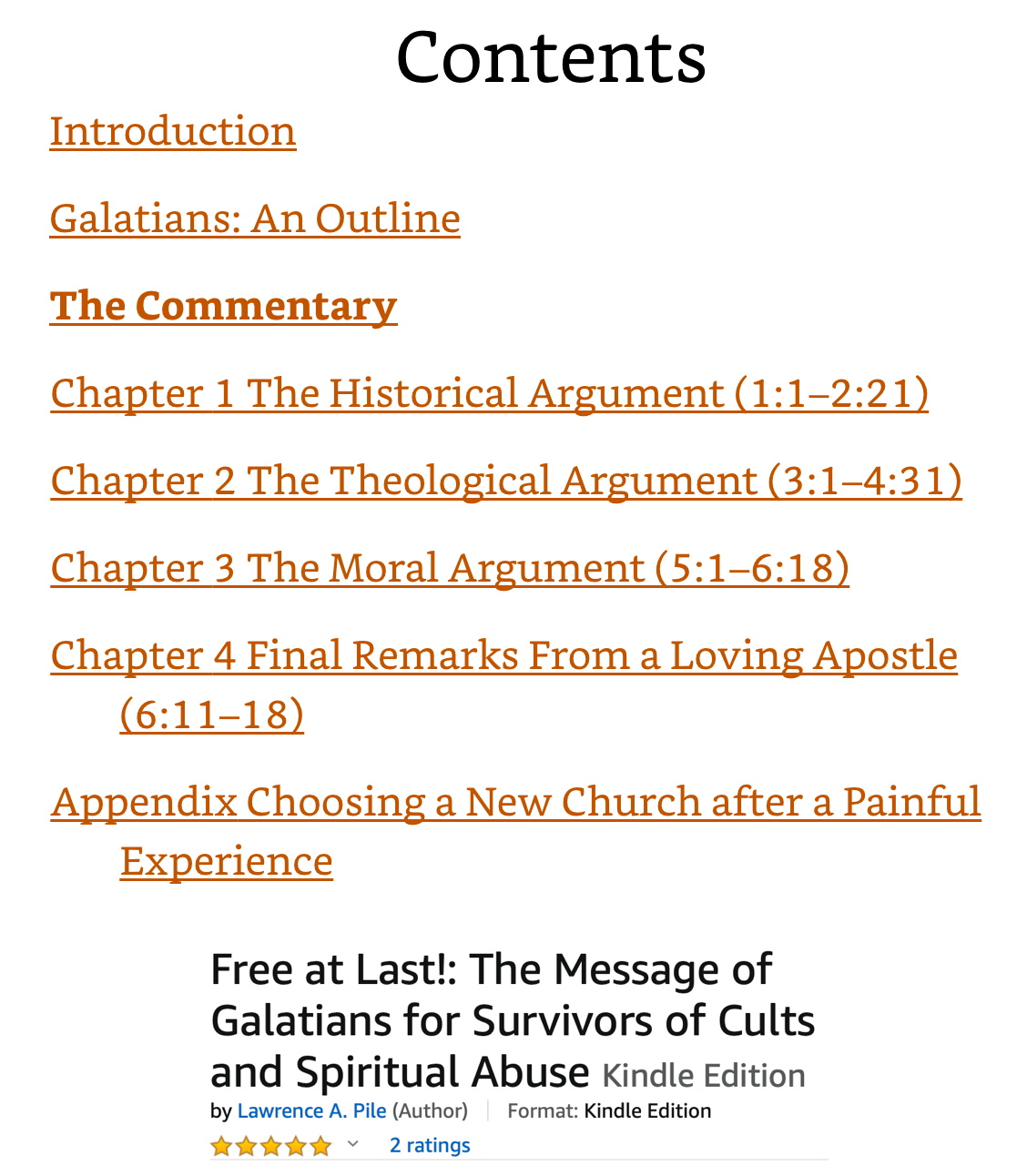
A Study of Galatians for Those Who Have Exited Cults

One of the wisest men I know finally finished his book on Galatians. I've read sections of the Bible Study a few years ago, and it was brilliant. I just downloaded the very affordably priced Kindle copy from Amazon.com, and I look forward to delving into it.
Tuesday, December 3, 2019
Lamenting Labors and Legacies

I always find great pleasure when speaking with Dr. John Weaver. As he waits for the upcoming release of his latest work, Technology, Management and the Evangelical Church, he's busy thinking about his next book – all of which became necessary for him to write after learning more about the complicated tapestry of abuses within the modern Evangelical Church in the US. I love how he sets me thinking about the language that I use, his rich sense of scholarship that drives questions about the origins of terminology, and how it affects us.
Thursday, April 27, 2017
How “Marriage Minutes” Helped Me Let Go of the Hunger Artist

Allegedly
a book review of Gerald Ford's
Marriage Minutes
,
it
ended up becoming a celebration of my egalitarian marriage with my
husband and
about the unexpected the effect that the book has had on my life.
The
first time that I ever heard anyone use the term “egalitarian” in
a conversation was my husband, just after we'd first started to date.
I seemed to prefer the patriarchal approach, even though I grew up
in a church that ordained women. My church had more female elders
than male ones, but as a daughter of sock hop era parents, I was
quite comfortable with patriarchy.
As a child, I also watched some
of those women elders inappropriately reject and strongly criticize
pastors in conversations to which I never should have been privy.
When the spiritually abusive church that my husband and I would one
day join preached that women were meant to be reigned in and ruled
over, I was willing to play along. I thought of the errors in
judgement made by two women – events that were filtered through my
poor understanding as a child. Patriarchy provided a very simple
answer to a terribly complex situation.
Monday, April 18, 2016
Daffodil Season Ends but Recovery Continues

Ironically, I'd just started blogging about the stages of recovery right before this happened, but I suddenly realized that I was living an experiential reminder, too. Stage One persisted for a good two weeks before it faded into decrescendo, mostly because I still can't understand that if people took issue with me that they didn't feel comfortable with approaching me. And the truth is that there may be no rational reason behind their actions.
Concurrent
with seeking stability came the grieving of Stage Two (Part
2)
as did remembrance (Part
3). That
grieving involved identifying and expressing my anger in a healthy
way – once I was able to identify it as anger. Some Stage
Three surprised me pleasantly in renewal of old friendships.
Elements of safety
in recovery emerged, too, for I found that while I was coping
with my own emotional soup, those who love me also became offended on
my behalf. At times, I had to juggle their responses when I wasn't
exactly in the best form myself.
Integration
and Reconnection
Though
I hate to realize it, this challenge did affect me strongly enough
that I've recoiled in constriction.
Though a string of my own illnesses and my concerns for my aging
cat's health have added to stress, I realized that I'd fallen into my
familiar old pattern of retreat. Friends have been calling,
wondering where I am and whether I still love them.
As my
shock and awe abates, I'm now faced with connecting again with those
things and people from whom I've backed away. Social
isolation never helps, and I find myself working hard to pull out
of it. Time with others heals me, but I feel weary. I've neglected
self care along with my friends. I struggle to attend to work
projects as the stress of the conflict seems to run at a low level,
but constantly in background in my mind.
 Then
there are other things that leave me weary like the announcement that
CJ
Mahaney was speaking at The Gospel Coalition. I also look
forward to writing about Eric Pazdziora's the beautiful lament that
he
composed for Lydia Schatz which was recently featured at a
Chorosynthesis event. (Lydia was the Liberian adoptee
who died a few years ago due to beatings according to her
parents' observance of Michael Pearl's teachings.) John Weaver's
excellent
new book about the New Apostolic Reformation brings up another
set of ideas and history that I must revisit as I read.
Then
there are other things that leave me weary like the announcement that
CJ
Mahaney was speaking at The Gospel Coalition. I also look
forward to writing about Eric Pazdziora's the beautiful lament that
he
composed for Lydia Schatz which was recently featured at a
Chorosynthesis event. (Lydia was the Liberian adoptee
who died a few years ago due to beatings according to her
parents' observance of Michael Pearl's teachings.) John Weaver's
excellent
new book about the New Apostolic Reformation brings up another
set of ideas and history that I must revisit as I read.
 And with both Eric and John who could almost be my sons age wise, in my joy over their recent accomplishments, there is a tinge of melancholy. I planned on having my own children but I didn't get the life I ordered. In this season of remembrance for me and as I approach my fiftieth birthday, the subject of opportunities lost takes on greater significance. Eric has also been a kind ear and encouragement for me as I set out to reclaim my connection to music which I largely buried after I left my church nineteen years ago. (That's part of another aspect of my ongoing recovery that finally emerged about a year ago.)
Reconnection
and Moving On
So here
I am, waiting to see what unfolds regarding my relationships with
people who are claiming that there are elephants in the room. I have
a talent for pointing out the fact that naked emperors have no
clothes, often at the worst possible moment. I have to interact with
many people involved in the telling and in the hearing of the
elephant tales before we all have a good opportunity to address these
matters.
I must
make it an adventure of learning not to care too much about those
things which I can't do anything about. I may ultimately just chose
to walk away from the endeavor that links me to these critics. I
might stay involved but just suffer the slings and arrows of
outrageous ideas because it's just not worth the effort of opposing
them. I can't end them, either, but I can address them assertively.
Not knowing more about how the conflict will end doesn't feel very
comfortable for me.
Climbing up to the High Road
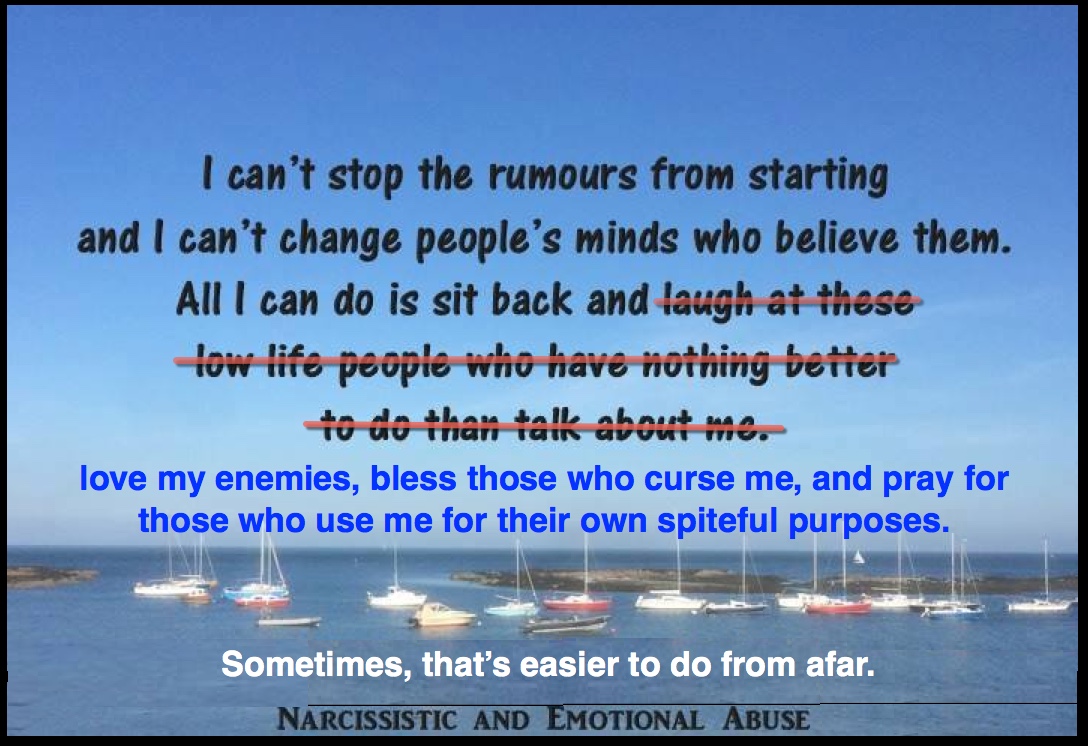
On the surface, it sounded good, and a part of me said, “Yeah!” But the more I thought about it, the more I felt that it was wrong to foster more division by essentially returning cruel behavior with equally cruel behavior and condescension. Two wrongs don't make a right. While the person who lies about someone deserves to face thos consequences, responding in kind doesn't solve anything. It only fosters more conflict, and it feeds into the power struggle that the first party tried to establish.
I must choose whether I want to stoop to returning evil with evil or whether I want to “take the high road.” When I read the “lowlifes” moniker, I decided that I didn't want to feed name calling. Ideally and while it may be too much to ask, my ultimate goal in these relationships in particular aspires to reconciliation. I have to follow that course for my own sake, so I need to climb up out of the hurt and think about walking the high road.
In
the next post:
How
I found a map to the “high road.”
For further reading until the next post:
- Judith Herman's Trauma and Recovery
- Peter Levine's Waking the Tiger: Healing Trauma
- Bessel Van der Kolk's The Body Keeps Score
Thursday, February 6, 2014
Commonalities Between Shirley Taylor's New Book and the Bill Nye/Ken Ham Debate? A Review of “Women Equal – No Buts”

Thursday, January 16, 2014
Kathryn Stegall's Book Addressing the Gender Debate

I will finally
start here!
Her book presents the power of the Gospel more than
anything else, simply by focusing on Scripture, and the doctrines
shine through in the process. Though the declared subject of the
book concerns this modern gender debate that has come to the
forefront in the Evangelical world, I think that it's really more of
a book about soteriology:
what salvation is, how it is obtained, and what it does for those who
put their faith in Jesus. I imagine that as a Christian writer, one
couldn't ask for more. Through a focus on Scripture, the book dispels
competing and idolatrous doctrines that rob God of His glory, power,
authority, and ongoing works that belong to Him alone.
Wednesday, July 24, 2013
A Review of Shirley Taylor's “Dethroning Male Headship” (Celebrating the Third Anniversary of the Demand Letter and the founding of the Freedom for Christian Women Coalition)

I so often pray
that the eyes of the Lord will look to and fro about the earth,
seeking for one to whom He can show Himself as strong, and that, by
His help, I will be fit for Him to notice. I pray for his help to
enlighten my understanding so that He will show Himself strong to me,
in all His depth and width and height as my life unfolds, being
gentle with me as He brings me deeper into that sweet fragrance of
the knowledge of Him. But I find that I also look to and fro,
looking for people who will have the strength and the willingness to
step forward to speak the truth, and I pray that God shows Himself
strong to them, too. We have too few of them today.
Tuesday, July 23, 2013
The Exploitation of the Traditional Use of the Term of Headship (A Prelude to a Review of “Dethroning Male Headship”)
.jpg)
Before venturing into a formal review
of Shirley
Taylor's new book, Dethroning
Male Headship, I wanted to comment on the use of the term
itself. She recently posed the question about when the term became
popular and with whom it originated. (I first heard it in
Presbyterian churches which I started attending in the '90s, and no
one with whom I've inquired can remember “male headship” as a
term before this time either.) Though the concepts of
subservience and scapegoating of women have been with us for a long
time, the term is a relatively new. The points I make here are not
part of Shirley's book, but I think that they are worthy of
consideration.
Thursday, July 11, 2013
Role Models, Books to Read, and Big Shoes to Fill

Friday, February 8, 2013
Good Books and Resources that Explore Forgiveness

Friday, December 7, 2012
Loved Ones Who Repeatedly Hurt Us: Landorf Heatherly's “Irregular People”

They don't necessarily have to
be family, but they usually are – those people we can't easily
avoid and are in our lives whether we want them to be or not. (They
probably wouldn't be if we had that choice.) They can't be reasoned
with, they disappoint over and over again, and when you really need
them, they are usually not supportive. They break our hearts through
rejection and poor consideration.
Things get even more complicated for us if these irregular people happen to be our parents who offer us some support. This reminds me of the relationship that a battered wife has with her husband who supports her and is often quite demonstrative with gifts and loving gestures, making the physical violence harder to put into perspective. The good is supposed to compensate for the very bad. (Susan Forward calls this the “FOG” in Emotional Blackmail, an acronym that stands for “Fear, Obligation, and Guilt.”) Much anguish and confusion results within these relationships with "irregulars."
Things get even more complicated for us if these irregular people happen to be our parents who offer us some support. This reminds me of the relationship that a battered wife has with her husband who supports her and is often quite demonstrative with gifts and loving gestures, making the physical violence harder to put into perspective. The good is supposed to compensate for the very bad. (Susan Forward calls this the “FOG” in Emotional Blackmail, an acronym that stands for “Fear, Obligation, and Guilt.”) Much anguish and confusion results within these relationships with "irregulars."
Tuesday, December 4, 2012
When Your Family and Loved Ones Offend You

Tuesday, March 6, 2012
Journaling for Personal and Spiritual Growth

A good counselor will tell you to keep
a daily journal. There are many articles online that talk about the
new data which shows the mental and physical health benefits of the
practice, in addition to the sage old advice about the benefits of
the discipline. Google puts them right at our fingertips, so I won't
spend much time here on that subject.
Monday, January 23, 2012
Journey Out of Shame: A List of Resources
Original post 19Jun08; Update Jan2012

Almost four years has elapsed since I first developed this list of helpful books and information for coping with shame -- specifically the type of toxic shame in adulthood that results from deficits in emotional development. If you found the discussion of the characteristics of a child and how immature parenting affects adults, you will benefit greatly from these resources. Explore the whole series about the childhood roots of victimization HERE.
I've broken down the titles into Christian resources and secular ones.
CHRISTIAN RESOURCES
Concerning Emotional Developmental Deficits and Recovery
From Shame to Glory by Kathryn Chamberlin, LCSW-C
 |
| Buy the Book on Amazon |
Audio and Video Presentations
 Kathryn attends the Fourth Presbyterian Church in Bethesda, Maryland, a church that is a member of the Evangelical Presbyterian Church denomination, following the Westminster Confession of Faith and the Heidelberg Catechism.
As you are free to note on her webpage, she holds a nursing degree from University of Virginia, a Master's Degree in Social Work from The Catholic University and certification in Biblical Counseling. She practices Christian counseling with the Bethesda Counseling Group, offering services to those in the Baltimore-DC Metro area.
Kathryn's presentation, “From Shame to Glory” is perhaps the best place to start a journey out of shame and into the liberty that is afforded to all believers in Christ Jesus. She has several other audio resources available, and I would also recommend considering these additional presentations as well:
- Shame versus Worth
- The Approval Addict
- The Performance Trap
- Hurt Trail to Idolatry
- The Door Metaphor
Books for Christians in Recovery (In descending order of importance)

- Love is a Choice. Hemfelt, Minirth and Meier's book examines the problem of persistent shame in the Christian's life. Christ saves us from the shame of sin and restores us, but for those of us who have been raised in families that were lacking the support we desperately needed, we tend to get stuck in patterns of shame that can prevent us from fully embracing the fullness of our forgiveness and liberty in Christ. Their ten step program teaches about how we can get caught up in repetitive patterns of shame and how we can be liberated from shame. ** They also offer a companion workbook (which I have not read).
- Forgiving Our Parents, Forgiving Ourselves. The book that I believe helped me the most during my own recovery has been David Stoop's book, Forgiving Our Parents, Forgiving Ourselves: Healing Adult Children of Dysfunctional Families. The aforementioned book (from the same publisher) presents an overview and an introduction to the topic of the less than ideal emotional development of a child, but Stoop's book takes healing to the next level and explains more specific information about how to heal. I found myself in its pages in a deeper way, amazed at how accurately it described the patterns that I'd lived.
- Boundaries. As mentioned in recent posat and featured in this blog post concerning a child's characteristic of vulnerability, Townsend and Cloud's book explores the issues concerning boundaries from a Christian perspective. In addition to their landmark book, you can also find a host of resources and video clips on important topics at Cloud-Townsend Resources online. The authors also adapted their message about boundaries and authored subsequent books which focused on particular types of relationships, and they are worth considering as well, though I am partial to the first book because it reviews boundaries quite extensively.
- The Lies We Believe and the companion workbook which adds significantly to the material in the book. The author, Dr. Chris Thurman, explores the false ideas that we hold about the world -- ideas which only serve to set us up for heartache. I think of this book as a more structured way of looking at spiritual warfare and bringing every thought captive to the truth, but it is focused on the issues of shame and negative emotion. Through this book, I learned that what healing professions call "Cognitive Behavioral Therapy" or working through negative emotion by exploring unrealistic expectations and false ideas about life was essentially the same thing that the Bible teaches by renewing the mind and bringing thoughts captive to Christ by using the Bible as a standard. David Stoop also has a similar book dealing with the topic called You Are What You Think, presenting the same approach to right and healthy thinking -- renewing the mind with healthy thoughts and ideas.
- Lewis Smedes' many books on the topic of forgiveness. I cannot recommend the writings of Smedes more highly enough on one's journey to better understand forgiveness in a healthy way and from a very Christian perspective. He has a host of titles, and I've found them all equally helpful, even though all of the aforementioned authors and books listed here touch on the subject.
- This is Your Brain on Joy. If you've followed this series and found a great deal of benefit through the focus on brain as an organ of the body that deserves special care and consideration, I highly recommend reading Earl Henslin's Christian book which presents not only a plan to help balance mood and restore brain health, but also focuses on spiritual growth. His balanced, Christian approach makes the topic very understandable and practical, taking into consideration the concerns that many Christians have, promoting good stewardship of both mind and body.
- Quivering Daughters (for women). Though Hillary McFarland's book focuses on the plight of young women who grew up in the radical end of the homeschooling movement, I believe that any young woman who grew up under shame-based and enmeshed parenting as an Evangelical Christian will benefit tremendously from this book. I am an example of those who can identify with the patterns of enmeshment, though my parents were neither radical conservatives nor was I homeschooled. The patterns of enmeshment do convey, and I believe that any woman from a background of religious condemnation and shame can glean a great deal from the book.
- Make Anger Your Ally. Neil Clark Warren's book (published by Focus on the Family) explains anger from a Christian perspective, focusing on the benefits of anger as a protective mechanism and how to deal with the triggers of anger in a healthy way that we might all observe the Apostle Paul's admonishment to "be angry and sin not." There is also a title on anger in the Minirth Meier/New Life series of books, though I have not read it. Some might find this helpful, as understanding anger presents a significant challenge for many who were raised in evangelicalism that perceived wrongly that anger itself is sinful.
- The Enmeshed for Jesus blog! Read many excerpts from these titles on this site's sister blog, which deals directly with the topic of shame-based parenting and enmeshment as it relates to the patriarchy movement.
- Other Christian titles on the subject of emotional developmental deficits. Hurt People Hurt People (Wilson); Families Where Grace is in Place (VanVonderan); Hiding from Love (Townsend); The Healing Path and and companion workbook (Allender).
Online Recovery Resources (some of which are free!):
- Check the National National Association for Christian Recovery website site for searchable archives, their blog, and list of constantly growing resources
- NACR online video workshops
- Free library of articles from back issues of STEPS magazine
- NACR audio workshops (for a nominal fee)
- Meier Clinics' list of online articles discussing a variety of topics
- The (aforementioned) Cloud Townsend Resources site with topical videos
Devotionals:
- Rooted in God's Love (NACR, available as a book and as a free daily email)
- Meditations for Christians who Try To Be Perfect (hosted on NACR by Joan Webb (available as a book)
- Northstar Devotional Blog (online resource)
- 12 Step Life Recovery Devotional (Arteburn and Stoop)
Online Forums:
- Christian Recovery International Forums (Both NACR forum and a spiritual abuse forum)
SECULAR
RESOURCES
RESOURCES

Depending on how the first two resources minister to you, and depending on the nature of the areas that God begins to heal in your life, I would recommend choosing between a Christian and a secular resource.
Overview, Introduction, and Healing
If you find yourself very compelled by this series and are at ease exploring secular writings, I would consider reading some secular material concerning shame and recovery. Though any book on the subject of shame or codependency as it was once popularly called would be appropriate, I find that these titles have been very good. These have all been time honored and standards in the area of overcoming shame.
- Codependent No More, Beyond Codependency and Codependent's Guide to the Twelve Steps (Melody Beattie)
- Facing Codependence and the companion workbook Breaking Free (Pia Melody)
- Compelled to Control (Miller)
Enmeshment
If while reading this series of posts, you identified with the subject and experience of enmeshment and the information on the Overcoming Botkin Syndrome blog, there are titles that specifically deal with that subject.
Etc.
- The Emotional Incest Syndrome: What To Do When A Parent's Love Rules Your Life (Patricia Love)
- Facing Love Addiction: Giving Yourself the Power to Change the Way You Love (Melody)
- Toxic Parents (Forward)
- Silently Seduced. . .Understanding Covert Incest (Adams)
- When He's Married to Mom: How to Help Mother-Enmeshed Men... (Adams)
Etc.
There are also a host of titles that concern intimacy and specifically delve into issues of parenting. I cannot begin to list them all, and my personal journey is unique, but I found these secular titles particularly helpful to me in my own journey of recovery. **Highly recommended**
- **Trapped in the Mirror: Adult Children of Narcissists and their Struggle for Self (Golomb)
- **Who's Pulling Your Strings (Braiker)
- The Drama of the Gifted Child: The Search for the True Self (Miller)
- The Gifted Adult (Jacobsen)
Sunday, May 8, 2011
Who Won a Copy of "When Sparrows Fall"? (and win a copy of Jon Zens' "No Will of My Own")

Today's post is just a tad silly!
I guess when you have cats help you, that's what tends to happen. ;)
Wednesday, April 13, 2011
Listen to Blog Talk Radio to Win a Copy of Meg Moseley's “When Sparrows Fall”
I've decided that every so often, I will raffle off a book or two to those people who send me an email with an appropriate answer to the mystery question of interest or other stated response.
How It Works
This time around, I'll collect responses until May 3rd (the day that Meg Moseley's book officially launches), and from the best responses, I'll have my husband or maybe one of my cats select two names at random.
To whomever gets selected, I'll send a copy of Meg's new book, When Sparrow's Fall. Read my review of the book HERE. So send me your name, address, and your response to the email address listed in the picture below, and I'll send off a book to you. (I'll delete/destroy the contact info after the raffle! I just want to have it for the sake of expediency.)
Also let me know if you'd like me to post your response here at UnderMuchGrace.com after the raffle.
Wednesday, February 9, 2011
The Aim of Every Artist: Meg Moseley's novel, "When Sparrows Fall"

"The aim of every artist is to arrest motion, which is life, by artificial means and hold it fixed so that a hundred years later, when a stranger looks at it, it moves again since it is life." William Faulkner
Every new generation experiences life uniquely, rising to meet new challenges in a new ways. Though the basic responses are not generally unique, each generation strives to make their efforts uniquely their own. In an attempt to solve the host of problems created by government schooling and while achieving many good ends at the same time, the '70s and '80s birthed the homeschooling movement. It is an excellent option, though public schooling was once what many believed to be an excellent option which solved a different set of problems for them in their day. How each generation or group of people solves their problems creates their history, yet because we are imperfect human beings, new problems always arise with those new solutions. We demonstrate our true character as we acknowledge, take responsibility for, and confront what we've created. To avoid our responsibility, sometimes we even go back to resurrect or reinvent some old solution that worked for a previous generation, losing sight of our own specific purposes.
Meg Moseley, an experienced homeschooler, sought what Faulkner says every artist aims to do: to capture a moment in time, not only to preserve it for years to come, but she also introduces the daily life of a homeschooler to those who live differently. As Faulkner suggests, a stranger can look at “When Sparrows Fall” and gain a realistic and entertaining glimpse into the life of the protagonist, but I believe that homeschoolers will also benefit in a host of ways.
Monday, January 31, 2011
Meg Moseley Points the Way through Hardships in Homeschooling into Pathways to Peace
 About 20 hours ago, I laid in the dark, wondering what goodness could come out of my immediate state. In the expanded passage that Reinhold Niebuhr penned from whence the “Prayer of Serenity” originates, he petitions God to help him “find hardships as a pathway to peace.” I’m stuck in bed for the next day, though I want to be up, feeling better, and attending to all sorts of important and sundry things. I found it much easier to connect with hardship than with peace. Uncomfortable as well, I can’t even find my attention span in order to figure out where that pathway might be!
 In the mail today, I received a proof copy of Meg Moseley’s new book, “When Sparrows Fall.” It’s due for release on May 3, 2011 from WaterBrook Multnomah. This novel tackles the spiritual abuse experience through the eyes of a widowed homeschooling mom of six on her way to reclaiming “freedom, safety, and love ~ for herself and for her children.” The cause of my temporary sedentary status comes as a blessing in disguise just a few hours after my sad lament, and my pathway suddenly seems far more clear. I have a chance to read the book! It is my hope and prayer that this book will prove to be a great instrument of help and healing on the pathway to peace for the many others who will read it in days to come. Though I appreciate all of the important work that has emerged on this subject, I’m especially excited that another resource from a devoted Christian with some twenty years of personal experience in homeschooling will soon be available.
I’m curious and perhaps excited to see what will happen with my new relationship with “When Sparrows Fall” between now and an appointment I have tomorrow afternoon. ( I suspect that I will magically find my lost attentiveness hidden within it tonight.) While reading only the first ten pages, I stopped to read three short quotes to my husband. (Naturally, he followed with sarcastic eye rolls and sardonic comments such as, “Well, I’m glad we’ve never heard anything like that before!”) By page ten, I think I’d had about 25 flashbacks to things that were said to me in my own spiritually abusive past, and I’ve found two phrases that I’ve used as either titles or subtitles in my own blog posts. [I’ve learned that common phrasing is quite a common thing. Stated another way, the late Dr. Paul Martin said that though the sheep’s clothing that wolves wear changes, the way that they attack their prey and the wounds that they leave do not vary. The works of the flesh always look like the works of the flesh, especially the tactics that are dependent on language.]
 Still, I’m amazed at how much spiritually abusive vernacular Meg has artfully encapsulated within her book’s first few pages. I find most books in the Christian fiction genre “force” too much of the jargon into the narrative, even when I am intimately familiar with the subject matter, situations, and language. (That is to say, I don’t believe that the lacking spontaneity comes from lack of experience on my part but from a writer that lacks the necessary skill of translating their ideas into something very readable.) I found the first few pages of “When Sparrows Fall” to be refreshingly different, as though the words were pulled directly from countless conversations that I’ve had or witnessed or suffered myself. Understanding that Meg and I share some similar experiences with similar groups and individuals, that may account for the intense sense of familiarity her writing evokes for me. I’m curious to discover whether people from other types of spiritually abusive backgrounds find it as equally perspicacious, especially as the plot unfolds.
Since my attention span does seem to be hidden where I left them on page 15 of Meg’s book, I’m going to get back to reading, holding down the bed so that the cat who patiently waits can use me as her bed for the evening.
More to come about this exciting first of it’s kind -- a novel about the experience of spiritual abuse which has been woven into too many sectors of Christian homeschooling.
Visit Meg at www.megmoseley.com and on Meg Moseley’s Blog. Or better yet, unless you’ve got a frequent flyer card with Family Christian Bookstores, Mardel, or Books-A-Million and want to wait to purchase your copy there, go pre-order the book from Amazon.com. You can look her up on Facebook, too!
Friday, June 25, 2010
My First Entry in my Quivering Daughters Diary

Post originally published at UnderMuchGrace.com June 2010 as :
My First Entry in my Quivering Daughters Diary
Embarking on the Journey through Hillary McFarland's New Work
I started out the day and kept checking the door to make sure that the "UPS man" had not escaped my attention, and maybe he came and left my book at the door without knocking. Hopeful that my book might arrive yesterday, I checked the UPS tracking number that I'd received from the bookseller by email. It was in Pennsylvania at 7:36AM , at least a ten hour drive away at that point, so I was sure that it would not arrive that day. (I was excited and obsessed enough to actually go to the UPS website to see where the book was. Am I nutz? Rhetorical question.. Please don't send me emails. We already know.)
I'd made several trips down the stairs to check my doorway for the book by the time the knock came! The only time I've ever been this excited about something coming in the mail has been when I received my Nursing Board results in the summer of '86, and I kissed the mailman when I opened the letter! I also watched the mail like a hawk for my engagement ring that my husband sent via regular post from half-way across the country in '88. (He didn't insure it, and it took over a week to arrive.) Rather than kiss the UPS man today, to express my excitement and gratitude, I gave him a pretty little gift box of Choxie candy that I'd picked up at Target (on clearance, of course ;).
I’d called Hillary on the phone, as we’d arranged in advance to open our packages while we had each other on the phone, acting like excited, silly school girls.
Subscribe to:
Posts (Atom)