Showing posts with label PTSD Stage 1 Healing. Show all posts

Saturday, June 22, 2019

Continuing the Discussion of Cognitive Bias

Here we are, still plugging along in the ongoing discussion of cognitive biases. Track the progress here and via guest posts at No Longer Quivering to learn more about common CranioRectal Inversions that can put us at risk.

This focus aims at improving our habits to ensure our safety and self care, especially during recovery from a spiritual abuse experience. Further discussion of Judith Herman's stages of recovery from trauma await as we are still on the first one

I plan to update the index of related posts a few times a year, but please don't hold me to it. (Search queries are your friend.)


Sunday, June 24, 2018

That Tricky Survivorship Bias and Recovery

Just a reminder that the purpose of this discussion aims at stimulating thought and self awareness as tools to help those in recovery from trauma learn how to make safer choices. To make the discussion a bit lighter, we've defined Cognitive Biases as “CranioRectal Inversions” (CRI).

This bias fascinates me because it has a direct impact on how many approach recovery from post cult trauma syndrome, as I believe that people make this common error in their assumptions. It is one of the many attribution biases – wrong assumptions due to informal logical errors that are often based on too little information and consideration of the wrong perspective on that information.

Saturday, October 28, 2017

Reviewing Liking and Social Proof as Weapons of Influence

Just a reminder that the purpose of this discussion aims at stimulating thought and self awareness as tools to help those in recovery from trauma learn how to make safer choices. To make the discussion a bit lighter, we've defined Cognitive Biases as “CranioRectal Inversions” (CRI).

We've reviewed the effect that liking has on us, and we tend to comply with people that we like. Just to dig into this method of influence, lets consider some factors that manipulators use to persuade us with liking without our even realizing it:

Friday, October 27, 2017

Liking and Liked: More Attribution Biases that Merge Liking and Social Proof

Just a reminder that the purpose of this discussion aims at stimulating thought and self awareness as tools to help those in recovery from trauma learn how to make safer choices. To make the discussion a bit lighter, we've defined Cognitive Biases as “CranioRectal Inversions” (CRI).

The previous post detailed a few Attribution Biases that cause us to make errors based on our feelings more than sound reasoning, and we human beings naturally show a prejudice for those things that we already like. If we are good people who seek out other good people to accomplish good things, we don't tend to anticipate certain problems. This expectation intensifies when considering a religious leader because they should be experts in and practitioners of good ethics and morals. And if we seek them out, even apart from any kind of considerations of hierarchy or authority that might influence how we relate to them, we're likely to take for granted that they are ethical. We certainly would not seek out a person whom we didn't like.

Tuesday, October 24, 2017

When the Attribution Bias Makes Things Seem More Desirable

Just a reminder that the purpose of this discussion aims at stimulating thought and self awareness as tools to help those in recovery from trauma learn how to make safer choices. To make the discussion a bit lighter, we've defined Cognitive Biases as “CranioRectal Inversions” (CRI).

In the context of spiritual abuse and how biases effect us, I thought of other instances that strike me as similar to the Cheerleader Effect but involve more of what is actually a type of Attribution Bias. (There's more to come about that bias in posts to come.) There are several subtypes of this type, but I see the effects of what we see, believe is available, and find desirable as a consequence as similar to some of the factors that may be in play in the Cheerleader Bias. We also can tend to be more open to considering owning the same things that they do because the association connotes the idea that those things are somehow better than equally good alternatives.

Monday, October 23, 2017

CranioRectal Inversions Cheering Us On (The Cheerleader Effect)

Just a reminder that the purpose of this discussion aims at stimulating thought and self awareness as tools to help those in recovery from trauma learn how to make safer choices. To make the discussion a bit lighter, we've defined Cognitive Biases as “CranioRectal Inversions” (CRI).

Another very human trait with which perspective can trick us is most commonly known as the Cheerleader Effect. Some of it owes to the way that we process visual information against contrasting elements in a field of view, but we also have deep psychological wiring that also affects how we interpret what we see. Some of that might also involve the suggestion that if a person is photographed with other people, they must have relationships which include activities that are enjoyable enough to wish to photograph. At the most simplistic level, people look more attractive to us when they are in a group with others. No one seems to know exactly why, but ongoing research continues to validate that the Cheerleader Effect influences all of us.

Tuesday, August 30, 2016

Falling off the Ladder of Inference (Part II)

Please see Part I HERE
for the Introduction to the Ladder of Inference
and CranioRectal Inversion (CRI) #2     


Mental Tagging of Information

As I've defined the Ladder here, the third rung involves how we make sense of information so that we can store it and use it later – and how we make decisions about what to do in the present. That brings up an interesting element of this phase of the process: time and pressure. When factors place a limit on the time we have to observe, think, and then decided on a course of action, we encounter a whole other set of types of biases. If given more time and less pressure, we have the luxury of being more circumspect and discerning. Manipulators also take advantage of this kind of pressure, and unpleasant circumstances also affect how we both take in information but especially how we tag or categorize it.

Cognitive Biases: Falling off the Ladder of Inference (Part I)


(photo credit)
Well, we don't actually fall off of it.
We just don't climb it very gracefully,
and don't end up where we'd like.


Before diving into additional cognitive biases, let's take a look at how we can put them into perspective by considering the Ladder of Inference. (We named the Hindsight Bias as our first in the CranioRectal Inversion (CRI) that results from falling into their trappings. Honestly, I intended no pun when I wrote that post and created the image!) Think of the Ladder as a section in the toolbox for cultivating safety in recovery from trauma, and you may choose to tuck cognitive biases neatly into it.

Friday, August 26, 2016

Cranio-Rectal Inversion #1: The Hindsight Bias


Looking at cognitive biases can be a sticky business because it's a term used in psychology, but the tricks our brain can play on us can overlap with other concepts and errors. Geeks coined the term in the 1970s, but we see elements of the things in our daily lives. The same kinds of errors overlap with logical fallacies to which these biases in thought contribute. I see the “weapons of influence” used in sales as a blending of both, just as thought reform does (according to those other geeks who coined those terms).

So in the interest of understanding ourselves, the world around us, and how we might safely fit into it, lets dive right into a lighter one first.

Thursday, August 25, 2016

Cranio-Rectal Inversion and Cognitive Bias


(You can't live very safely if your head's up your _____.)

The title of this post conveys a rude image, but I find it sadly and uncomfortably true. In pondering my own recent disappointments in life and establishing safety in trauma recovery, I found myself looking squarely at my own cognitive biases. And I realized that you can't see and hear if you've buried your head away somewhere, even if it is self interest.

Cognitive” refers to thinking ability, and when teamed with “bias,” it refers to errors in our thinking that result in faulty judgements and poor decisions. The good news? We expereince them as a function of our humanity, and they don't seem much like biases or errors when we fall into them. And if you think about it, a life well lived might just be the long process of “pulliing our heads out” over the course of our lives concerning all sorts of sundry matters as our world and our experiences expand.

Sunday, August 21, 2016

Fly Away from the Dream Squashers for Safety and Stability


http://www.123rf.com/photo_60923790_stock-vector-toy-space-rocket-with-smoke.html
pic credit
When preparing to write this post, I kept thinking about a scene on Everybody Loves Raymond where one of the characters named Robert says something quite true about what he calls “dream squashers.” Deborah, his sister-in-law, discusses returning to her career while the rest of the family focuses on the negative aspects of the idea. I identify with how Robert recounts his childhood dreams as he encourages Deborah to “strap a rocket on her back” so she can fly away from the naysayers – the dream squashers. It helps me make light of things, but the statement that he makes is very valid.

Safer Decisions: A Tough and Challenging Topic


I'd hoped to follow the previous post about how we make decisions and the risks we take with something more positive. As I'm walking through my own personal labyrinth of recovery from new challenges, I couldn't connect with the material very well.

In a way, it demonstrates the difficulties that we face when we do build Safety and work at Stabilization for ourselves as we recover from trauma. Life also gets in the way of that, as we have to go on living our lives as we heal. We still have our daily work, routines, and our ongoing care of self and others. My life has had the added elements of a couple of recent deaths including the suicide of a friend, the loss of my 16 year old cat last month, a flaring up of more than a few chronic illnesses, and a serious injury in my immediate family. These make the daily grind of all of the other pressures of life that we all share in common (like the rising cost of everything and enduring pre-election politics) that much more of a struggle.

Tuesday, August 16, 2016

Managing Ignorance and Knowledge in Recovery


Ignorance (lack of knowledge) affects all of us. Recognizing that you lack knowledgeable about something and seeking information or advice shows strength of character as well as wisdom in decision-making. The true problems arise for us when we don't realize that we're ignorant about a matter and to what extent our knowledge reaches. In the discussion of risk, often times, no one has information about uncertainty, but just that knowledge alone can help you make wiser decisions. So while you may feel like you're standing on the edge of a precipice and just might fall in to trouble, the fact that you're aware of your footing and your limitations does provide a great deal of power about what you can do and how to prepare for what you might face.

This post is also another one that looks at hard facts that can be difficult to thin about but will perhaps help us identify pitfalls that affect how we manage acceptance, expectation, and growth in recovery from trauma.  The post which will follow will be more encouraging and pleasant!

Monday, August 15, 2016

Understanding Risk : Learning to Move Towards Safety


http://www.123rf.com/photo_20442545_fit-climber-going-down-the-large-pile-of-cut-wooden-logs.html
(photo credit)
I once heard a lecture about fostering critical thought that aimed at defining risk and the information that we have when we must make choices. Some choices are easier than others, depending on what may happen if we make the wrong choice, and if we've exited a high demand group, we are likely brutal perfectionists

The personal costs involved in making choices influence us, and access to information about the ways others have tackled similar choices also impact this hard work. Understanding these factors can help us to feel better about the process of decision making, especially if we feel a bit rusty.  I've warmed up with age, but I still often struggle with making big decisions, especially ones that concern optimism about myself.  But looking into taking risks can help us develop and practice optimism that can help us build as much safety and stability as we can.  All people need it, but at least we human beings are all in the same boat.

Sunday, August 14, 2016

Developing Tools to Find Safety in the Face of Uncertainty


In the discussion of building safety in stabilization in recovery from post traumatic stress, we've recently considered the role of acceptance and expectation in that process. We lose perspective because we get more consumed with survival for far too long which interferes with our ability to embrace joy and live optimistically. 

Understanding mankind's vulnerability in the grand sense gives a a map of the landscape, and creating a starting point of moments of safety give us a starting point. Learning how to safely move forward through the oft convoluted maze of healing also gives us a safe habits and help in that process.

Friday, August 12, 2016

Safety in Optimism as a Learned and Re-Learned Skill


Earlier posts looked at the grand picture in life concerning our expectations for safety in a world where things exceed our control. Camus defines well that we are stuck in the human condition which requires struggle and disappointment that doesn't end. Catherine Marshall looks to the acceptance of what Camus describes but differentiates hopeful acceptance from the pessimism of resignation that seems to be it's own kind of premature death. Today, I'd like to tighten that broad focus on uncertainty down to a more basic and immediate one.


Thursday, August 11, 2016

Safely Tucked in the Middle? Contrasting and Comparing Camus and Christy

https://www.amazon.com/Christy-Catherine-Marshall/dp/0380001411/ref=sr_1_1?ie=UTF8&qid=1470694476&sr=8-1&keywords=christy+catherine+marshall
Catherine Marshall authored Christy, the historical fiction novel which was based on her mother's experiences in a remote mountain community in Tennessee. In the picture shown here, I included a rendition of her book which features Kellie Martin who played the protagonist in the CBS TV drama that was developed from the novel a number of years ago. (I figured that her work might be more recognizable that way.) 

Wednesday, August 10, 2016

Finding Safety in Myths? Camus as Futlity's Starting Point

https://www.amazon.com/Myth-Sisyphus-Other-Essays/dp/0679733736/ref=sr_1_1?ie=UTF8&qid=1470692055&sr=8-1&keywords=sisyphus

I am by far a greater fan of Master of the Absurd, Franz Kafka, who laments in his writings about the nature of man and his limitations, but I could not help but think of Albert Camus' essay about The Myth of Sisyphus concerning the subject of futility and expectation. Can his writing help us find some footing in recovery from trauma so that we can build some type of stability? Trauma robs us of our sense of safety, causes us to feel isolated, and it obscures our memories of stability if we truly had any as a starting point. Trauma causes us to realize the reality of our fragile nature and alienates us from optimism.

This theme is of interest to me because of the problem of figuring out how to fix one's aim when it comes to expectations – especially in relationships. Camus sees the proverbial glass as half empty, and it won't be long before the liquid in the glass evaporates. What would the Apostle Paul recommend for us to consider regarding a glass that is only half full while there is great need for more help for our human condition? Sometimes, I feel the weight of Sisyphus rolling down on me and all of my fantasies because I've been badly burned by the idea that the glass will soon be full. Can I use the writings of the atheist of absurdity to figure out how to understand Paul's admonishment to be content and at peace, despite my very human circumstances in real life?

Monday, August 8, 2016

“Bloom Where You're Planted” as a Thought Stopping Cliche


I'd heard that phrase before, but even now and even with my positive experience with the concept many years later, the phrase still connotes something negative for me. 

The last post detailed my very good experience with the sage advice of determination to bloom and grow, even if it's not where you want to be or the conditions are not that favorable.

Sunday, August 7, 2016

The Good Aspects of “Bloom Where You're Planted”

https://www.amazon.com/Bloom-Where-Youre-Planted-Leisure/dp/1574867628/ref=sr_1_18?s=books&ie=UTF8&qid=1470616590&sr=1-18

Platitudes can be helpful when they're used well and when both parties understand what they're meant to communicate. Much like pictures, they can encompass and encapsulate more meaning that just the words in-and-of-themselves. They're verbal shorthand that can sometimes be more direct and concise than long discussions, and they're especially helpful when one party doesn't have a lot of emotional energy to stop and listen to a long explanation. We can all imagine a tenacious flower like a dandelion that grows in a tiny bit of soil that has inadvertently collected in a crack in a sidewalk. Sometimes life requires our tougher nature to prevail.

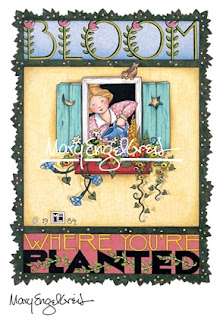
I remember when Mary Englebright's graphic arts became quite popular, and the picturesque phrase became a useful phrase for her theme of gardening. If you're safe in the place where you find yourself, figuring out how to thrive where life plants you, it's a lovely idea. When you're covered in mud, before a long soak in the tub after a day of gardening, the picture of the promise of burgeon buds and blooms keeps you going. As mentioned in the previous post, I think that it can be a great example of what that verse in Philippians means when it says to think about goodness to foster contentment.