Showing posts with label Adventures in Ambiguity. Show all posts

Saturday, January 30, 2016

Pendulums and Plumb Lines: Adventures in Ambiguity (Part X)


Like a swinging pendulum, when we exit a group, we can easily get caught up in the drama of life and created excitement, mistaking it for healthy living. (And keep in mind that as dynamic beings, we do swing out to extremes now and then, but we tend not to live in the extreme all of the time.)


This takes quite a bit of time for us when we exit a group. We have to learn what it feels like to be comfortable with balance – and for many of us, we had little to none of it to watch and learn and live. I, too, experienced my own swinging around to find my own balance, and I also still work at emotional self-regulation.


Riding out the Swing?

Pendulums are driven by inertia which keep them swinging until their energy depletes. The dynamics of being alive, like gravity's pull on a Focault pendulum always puts some drive into the swing as can be observed in science museums and with a tabletop pendulum which draws patterns in the sand, tracing the spin of the earth. The added energy from pulling the bob to an extreme angle from plumb and by the weight / mass of the bob translate to inertia which continues to power a wide swing.


By analogy, you probably can't do much about the chaos of the extreme angle where you started when you broke away from your rigid position of bounded choice.


Many of us end up in bad relationships or other bad religions as we work to find our balance. Personally, I swung over from Word of Faith into Shepherding/Discipleship/Gothard, because that extreme of a micromanaged life seemed like a better alternative to the “name it and claim it” chaos. All I'd done was swing to a new extreme. But that's okay. I also left the Gothard church and ended up at the same Presbyterian church that Doug Phillips attended! But with more ease with freedom, time, and healing, my own inertia started to drop.


What can a former member do?

Can you do anything to drop your force of inertia? You can drop mass. Work through the baggage of your trauma and your tendency to prefer extremes in life with a therapist. It will help to drop the mass that powers the extremity of your swing. Stay physically active and keep a journal to work on building good, healthy internal dialogue to develop peace with the concept of balance, grounding, and plumb, and all these things will take force out of your swing.

As you may note in the video below, everything swings based on its inertia. Note that the bobs on the shorter strings swing faster and long ones swing at a slower rate, but they all eventually lose inertia. Also take note that all the bobs in the video below are the same size. Drop your own mass to drop your inertia, and you can do that by working through your trauma and by learning about healthy dynamics.


PENDULUMS AND PERSPECTIVE


We are all different like the the varied lengths of the strings on which the pendulums are suspended. Our recovery will look different from that of others because we are all constructed differently and come from different places in life.

Another benefit? Drama drops to a minimum when we “find center” by finding plumb – and that takes much less energy that you can use to choose things that make you feel happy and fulfilled. You don't have to conform to the constriction of control any longer, and there's so much less drama and chaos. Life is still life with all of it's pressures and cares, but the former member can find that life offers choices that gives alternatives to the tiring extremes.


Thursday, January 21, 2016

Reacting from a Place of Vulnerability: Adventures in Ambiguity IX


Before developing as fairly functional internal locus of control and as strong sense of worth, and until former members work through how to relate to others with both good internal and external boundaries, things can be very difficult for them. There's so much to do immediately.

The insecure person tries to build a network of safe friends who can relate to them and hae their best interests at heart. This is healthy in the beginning of recovery, but after some time has passed, it becomes self-defeating and inhibits recovery and growth. Some fall into the trap of surrounding themselves with people who are more comfortable for them and go to great, unhealthy lengths to isolate themselves from people who challenge them. They work hard to have as much control over their external life as they can. No conflict means no struggle which translates into peace and self-worth for them.

Hypervigiance in the Wider World: Adventures in Ambiguity (Part VIII)


High demand groups manage tension and pain which arise from natural and healthy disagreements and differences by forcing uniformity. Again, we come back to the fact of life that we human beings are very dynamic and diverse, something that a group purports to “correct” for the member, giving the illusion that they've resolved that healthy tension. Anyone who espouses beliefs that are different from the group are discounted or demonized which further galvanizes the control that they hold over a member. In doing so, they force and reinforce the idea that the wider world outside of the group is very unsafe.

So what happens when a person exits a group? They lose their support systems (family and those associated with the group), they are in a state of hypervigilance because of the trauma of burying their identity, their critical thinking skills have been lulled to sleep in order to survive in the group which does their thinking for them, and the group has alienated them from their own autonomy. For those who have grown up in the group, they may never have experienced autonomy. There is no switch to flip that causes a person to reset and reboot. Whether they like it or not and on top of having to learn how to deal with the realities of life outside of their group, they find themselves saddled with a tremendous amount of personal development to do as they recover from their experience.


Developing Healthy Tolerance

As noted in the previous post, individuals need to find a place of dynamic balance concerning power as they learn where and how they fit into the world. High demand groups force extremism on the member, so as the individual recovers after exiting, but the unspoken rules of how to live in balance differ greatly from those that the former member lived out in the group. The group's allegedly protective rules for enforced uniformity and tightly controlled milieu of communication and experience exemplify an external locus of control.

In the wider world, life is full of ambiguity and diversity, but the rules for coping with the natural and healthy tension that arises from these contrasts prove to be much different. Remember that groups employ control and chaos, but in the wider world, tension and diversity drive personal growth. The world is not a fair place and can be dangerous, but the ideas about it and the ways that members cope with threat while in a group don't work well in life outside of their group. Former members have been isolated from or were never taught the two primary, healthy means of coping with interpersonal diversity: boundaries and locus of control.


http://undermuchgrace.blogspot.com/2012/01/shame-based-and-immature-parenting.htmlProtective Boundaries and Locus of Control

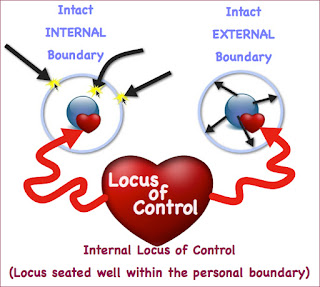
To give a picture to boundaries, imagine that your own sense of worth is a sphere. In a “good enough” family or group, your heart is full and you have all of the confidence and personal sense of peace that you need to live a happy, healthy adult life. Boundaries come along with that to help you weather difficulties in life over which you have no control. You have the power to choose what you leave into your heart and mind (an external boundary), and you have control over what you choose to say and do when with and communicating with other people (an internal boundary). 

http://www.amazon.com/Taiji-24-Step-Short-Step-Step/dp/1848190417/ref=pd_bxgy_14_img_2?ie=UTF8&refRID=1G7TFF4D9C37G8XWDXQ5Pia Mellody describes boundaries using the image of the starting posture in Tai Chi. One hand is extended forward (filtering out threats and danger), and the other hand is placed on the chest (expressing the power and discipline of self-containment) as noted on this book cover. Some of the descriptions of Tai Chi posture found here are lovely when considering the task of affirming self.

When your understand self worth and acceptance of the diversity as something good that is not an automatic threat (an element of an external boundary), and when this works in concert with balance of focus on those things which are squarely in your own power (internal locus of control), diversity no longer seems like a threat. Both of these concepts and attitudes about self create a sense of safety and strength.


Life on the Outside without Healthy Boundaries and an Internal Locus

Imagine that all you know about how to get along with others came from an unhealthy, manipulative, high demand group. The boundaries that you have are weak at best, and you've learned to earn your worth through performance. Peace and safety are vested outside of yourself, and you have no barriers to protect you from an unfamiliar world. You know conformity, and while you know how painfully difficult it feels to fit into a demeaning box that doesn't accommodate you, uniformity makes things much easier. And you need something that's a bit easy when you have so many other pressures that push and pull you. You've got plenty about which to feel angry and uncomfortable, and you are in the throws of learning what you should have learned when you were a child. You're tired, frustrated, and everything feels different to you. Diversity feels painful.


Without any protection, diversity and freedom feel good to you to experience, but when faced with the consequences or the ideas of others who are different from you as they freely express themselves, they feel like a threat. Most of what you know from your experience involves a code of conformity which served to protect you. You don't know how to filter out things that might feel painful to you. You've had little experience with thinking outside of a black and white style, though you understand all too painfully how it can hurt when directed at you. And when threatened, you will very likely go back into the default mode of experience – and that which you saw modeled for you. It takes time and energy to learn other ways of doing things, and your world was kept intentionally small.

And though you may have internal boundaries that are quite strong in terms of practice because you had to conform to a rigid standard of behavior, in other areas of life, it can be difficult to use the same constraint when you feel as though you've been targeted and attacked. Trauma, pain, and inexperience make us less resilient emotionally, especially when we are juggling so many new things and ideas, along with the struggles of life which are generally plenty. What do you do when you feel wounded and overwhelmed in your effort to regain a sense of safety and peace when you lack so much emotional self-regulation?


Tuesday, January 19, 2016

Finding a Healthy Locus of Control: Adventures in Ambiguity (Part VII)


We've already noted that a person's concept of self suffers while in a high demand group or family, since the member's sense of worth must be derived from the group. Though they may appear to have autonomy, their choices are bound and limited to that which is determined by the group.

Our sense of worth and our sense of personal power come together and support one another as we move away from following the “path of least resistance” dynamics that we lived and saw modeled in the group, but the group's way of doing things was not healthy. We want to avoid the pitfalls of power, but we also don't wish to hand our autonomy over to some new master – like switching drugs of choice.

Building on Emotional Self-Regulation: Adventures in Ambiguity (Part VI)


In the previous post, we explored the challenge of developing a healthy sense of personal power that we encounter when we exit a high demand group. How on earth can we get through life with a faulty set of coping tools, where do we go to learn them, and how can we figure out how to be balanced when all we've seen modeled for us is extremes of power and of emotion?

This topic is a huge one, but a person can do a lot of good work on their own to develop healthy Emotional Self-Regulation after exiting.

Monday, January 18, 2016

Pitfalls in Personal Power: Adventures in Ambiguity (Part V)


In the previous post, we explored a couple of ways a person can work on their own to develop better Emotional Self-Regulation after exiting or after growing up in a high demand group. Healthy internal dialogue and building self concept provide individuals with a good opportunity to do a great deal of healing and growth on their own.

Sunday, January 17, 2016

The Map is Not the Territory: Adventures in Ambiguity (Part IV)


And the territory is definitely not the map.  

This saying came from a scientist and philosopher named Alfred Korzybski who launched the study of how human understanding and the nervous system intersected, particularly concerning how language shapes our perceptions. He was a Polish-born Russian who served in World War I as an intelligence officer, but he became a citizen of the U.S. In 1940.

The original phrase that Korzybski coined in 1933 illustrates the problem of mistaking an abstraction of something for the genuine article. Another wise friend in the discussion where I first learned of this phenomenon pointed out that this is actually an informal logical fallacy called reification or concretism, a subset of fallacies in thinking that fall under ambiguity.

Saturday, January 16, 2016

Self-Regulation? What? How?: Adventures in Ambiguity (Part III)

How can I possibly know anything about emotional self-regulation? I was faced and am often still faced with the quandary of growing up without it, not really knowing that I lacked it, and then trying to figure out how to develop it. And though trauma therapy helped me make great strides to develop it, I still have my days...

The process works out differently for everyone, and some people have less difficulty than others.  This represents what I experienced in my journey thus far.

Friday, January 15, 2016

Emotional Self-Regulation: Adventures in Ambiguity (Part II)

http://en.wikipedia.org/wiki/File:Foucault_pendulum_animated.gif

In the previous post, we explored the problem created by the black and white thinking that was forced upon us in a high demand religious group. This is especially difficult if we grew up in an ideological group, because we likely didn't see anyone model moderation or another way of thinking. We end up adopting the strategy that if one thing is bad and unsafe, it's extreme opposite is likely the best safe alternative.

High demand groups don't tolerate uniqueness, and they make the mistake of defining uniformity as a type of unity. They don't tolerate much of anything that falls outside whatever their group defines as appropriate under their black and white rules. When we exit such a world of black and white thinking, we can't just flip a switch to make ourselves more tolerant, putting to rest the impulse to think in black and white. We have to go through the hard work of critical thinking first as we get some experience being flexible.

Thursday, January 14, 2016

Black and White Thinking after Exiting: Adventures in Ambiguity (Part I)

I spent much time studying chemistry, thinking about the Bohr Model of the Atom, and I was so fascinated by the periodic table.  I suppose that along with math, it seemed like one of the few consistent things in my life.  Language could be misinterpreted, but chemistry presented a fixed, definitive type of truth.  And I lacked that in my life.


How can something be true and untrue at the same time?

Then I bolt off to college at sixteen, still very young and desperately searching for consistency in life.  I didn't know who I was, really, but I could learn about reality around me.  Well, imagine my dismay when my freshman chemistry professor says, "The Bohr atom isn't really real.  It's only a theory."  The nice and neat picture in my head of electron shells that encircle an atom were merely a statistical means of representing how matter behaves, but it is all theoretical.  It's based on quantum theory, yet another theoretical science.
  I want my Bohr atom dream back!